
Keys & Kin · Issue 1 · Sat 10 Oct 2026
The bitcoin storage map: four stops, and the trade-off at each
Ask a bitcoin maximalist where to keep your bitcoin and you'll get one answer. Ask an exchange and you'll get the opposite. Both will sound completely sure of themselves.
Follow the money and it makes sense. I'll declare my bias first: I help people take self-custody of their bitcoin, so of course I'll tell you holding your own keys is the way. Exchanges earn when you buy and sell, so they'll tell you their smooth app and "institutional-grade security" make them the safer bet. Each side is selling what it does.
Underneath the noise, the choice comes down to what you value most: security, privacy or convenience. And that usually depends on how you see bitcoin. If it's a holding you keep in case the price runs, with no real interest in why it exists, you'll probably end up on an exchange. If you see it as your vote against endless money printing, you'll lean towards holding it yourself, where it's very hard for anyone to know about it or, God forbid, seize it. Plenty of holders sit somewhere in between.
In my experience, very few people choose how they will store bitcoin. They drift into an option, usually an exchange, without ever realising what options exist, what each optimises for and what trade-offs each makes. Spoiler alert: they all make trade-offs. You, however, get to actively choose what you are unwilling to compromise on and what trade-offs are acceptable to you.
So here's the full menu. Read it once and you're ahead of 99% of people, because you'll know where you stand and you'll be choosing with intent.
The map
Every way of holding bitcoin sits on one line with four stops. What separates them is the keys, because holding the private keys is the only way to move your bitcoin without asking anyone's permission.
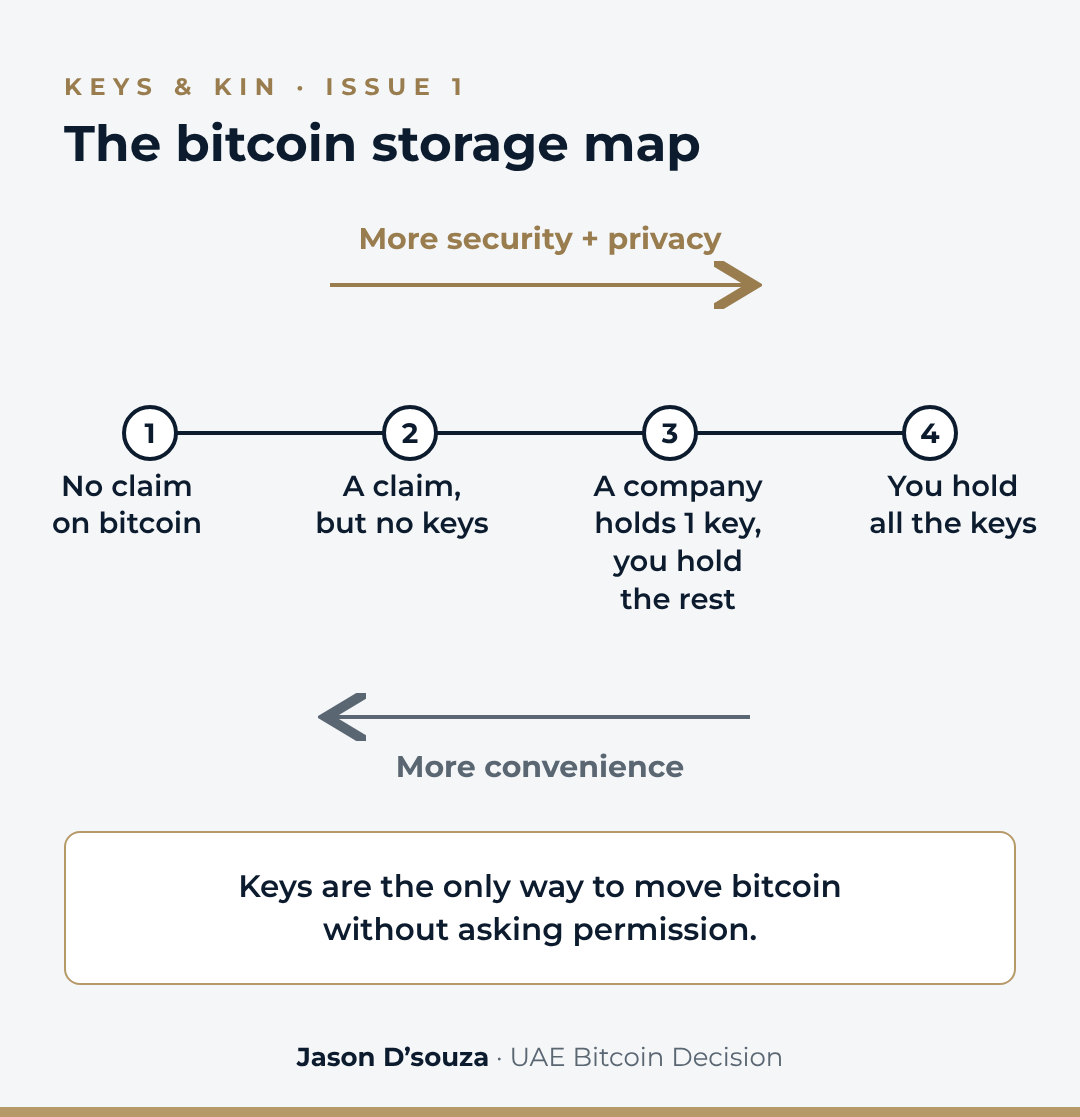
Move right and you gain security and privacy, but you take on more to learn and look after. Move left and life gets easier, but someone else's rules, systems and solvency stand between you and your bitcoin.
At every stop, companies have built products that solve one problem and give something up to do it. So for each one, ask: what is it solving for, what is it giving up, and is that trade-off acceptable to you?
Stop 1No claim on bitcoin
You can own bitcoin's price without owning a single bitcoin.
Spot bitcoin ETFs and bitcoin treasury company shares put bitcoin inside a container people already trust: a share in a brokerage account. No keys, no wallets, no new app. You get the full economic exposure (upside and downside of Bitcoin price fluctuations) minus a fee (example, IBIT is 0.25%), but you hold a security on a brokerage account rather than holding bitcoin in self-custody.
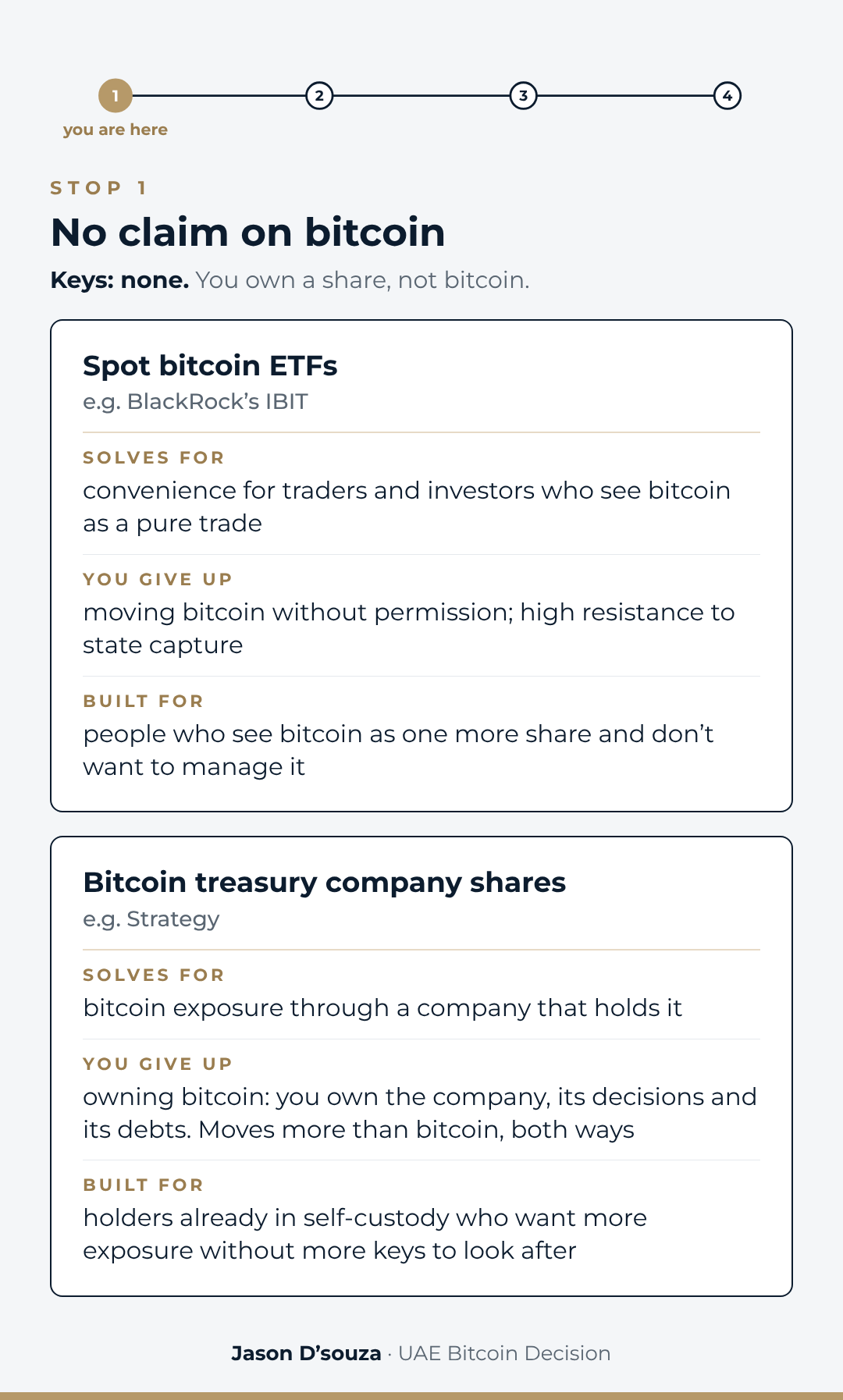
(Strategy also offers fixed-dividend preferred shares: STRK, STRF, STRD and others. Future issues will take each of these apart.)
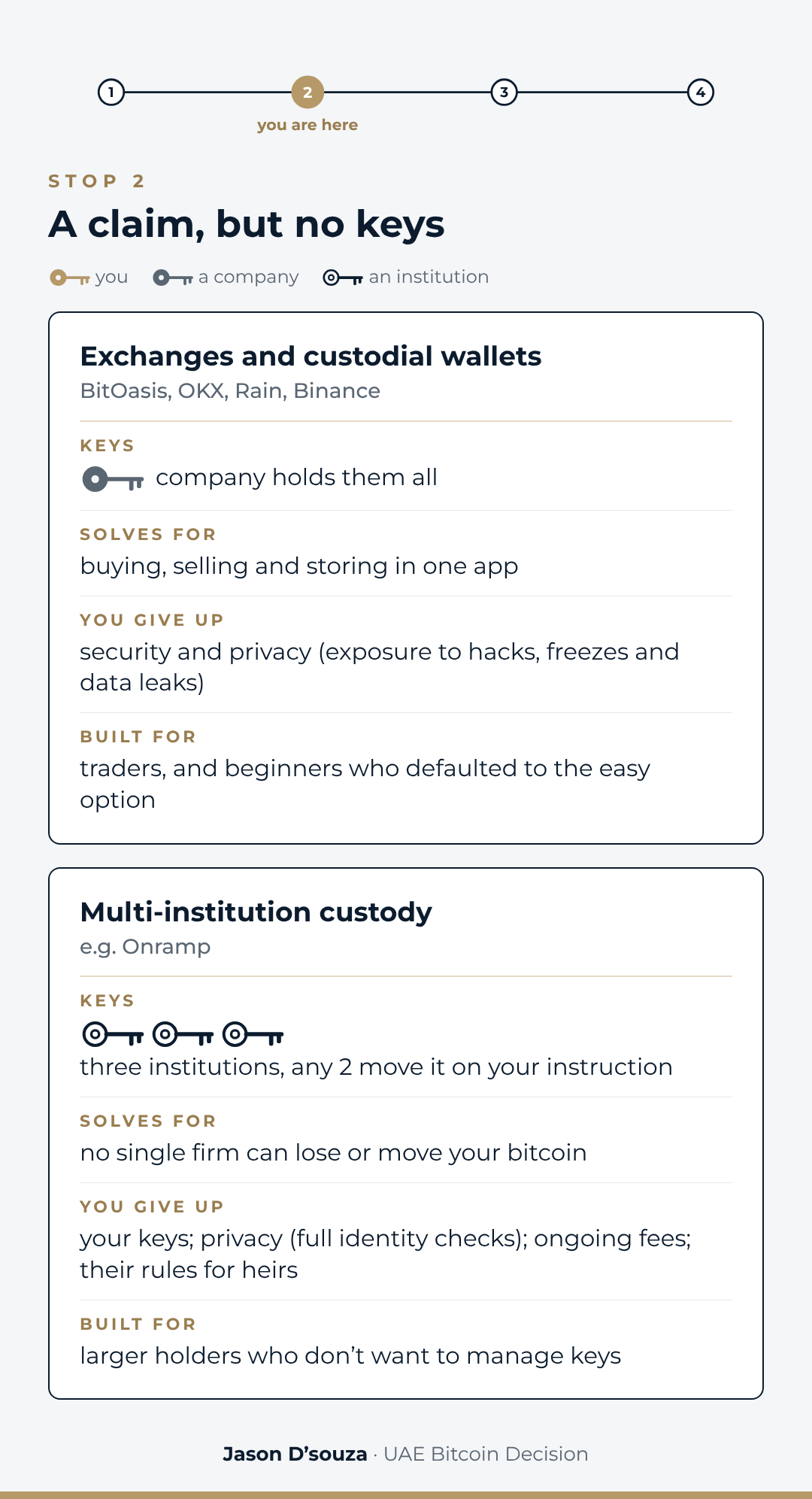
Stop 2A claim, but no keys
An exchange balance isn't bitcoin. It's an IOU.
Leaving bitcoin on an exchange is like leaving your gold with a jeweller and holding only a receipt. The receipt is fine, right up until the jeweller has a very bad year. And jewellers do: Mt. Gox customers waited about 10 years to get part of their bitcoin back. FTX customers were paid in dollars at the November 2022 price. Add hacks (Bitfinex 2016, Bybit 2025) and leaks of customer identity data (Coinbase, May 2025).
Multi-institution custody, like Onramp, removes the single jeweller. Picture your gold in a vault with three locks, each key held by a different firm. Safer from one firm failing, but you still hold no keys, and three licensed firms know exactly who you are and what you hold.
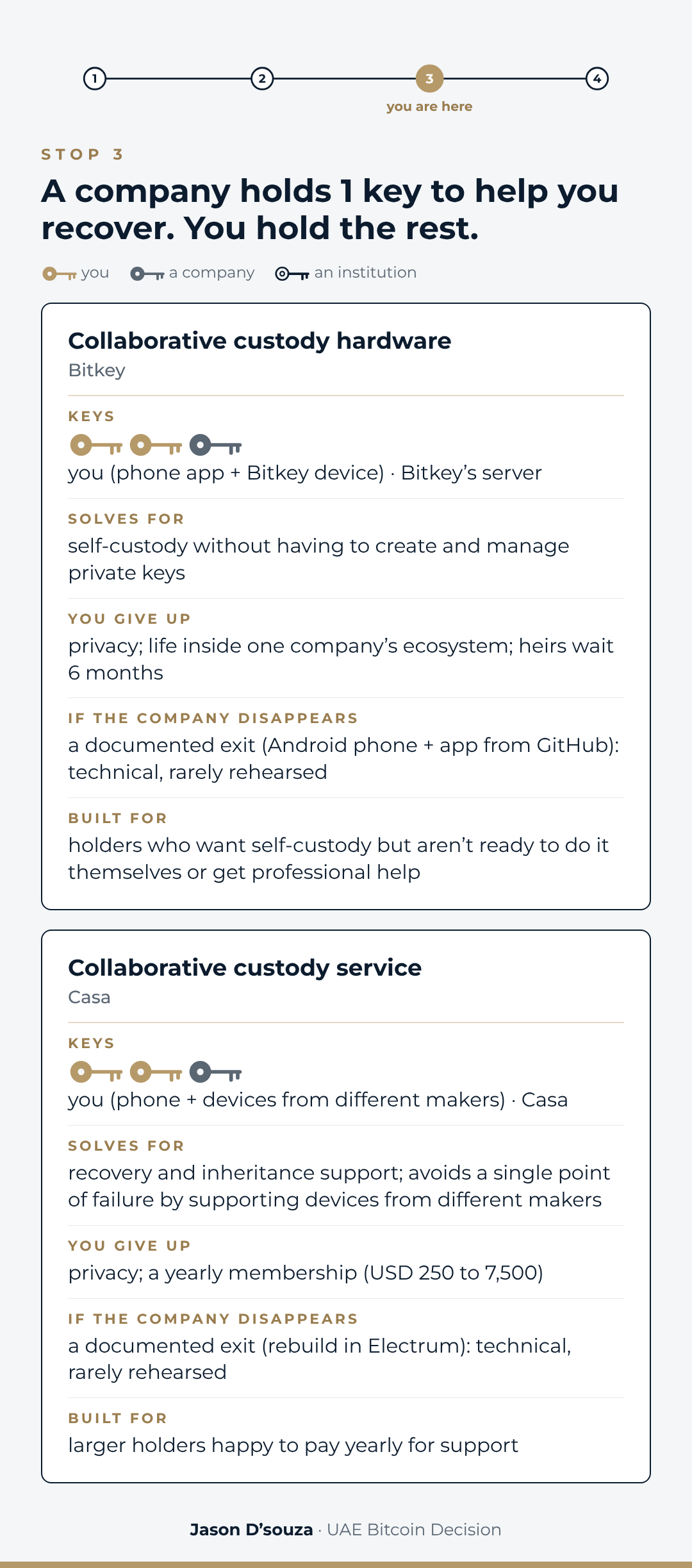
Stop 3A company holds one key to help you recover. You hold the rest.
The company can't move your bitcoin on its own. But it knows a lot about it.
This stop takes away the biggest risk in self-custody: a human mistake that loses bitcoin forever. Bitkey is like a building where the developer made the lock, cut your keys and keeps a spare in the management office. Casa is the same building, except you choose your own locksmiths and pay a yearly maintenance contract.
The question worth asking: what happens if the company disappears? Both have a documented way out (Bitkey, Casa), but it's technical, and few holders ever rehearse it.
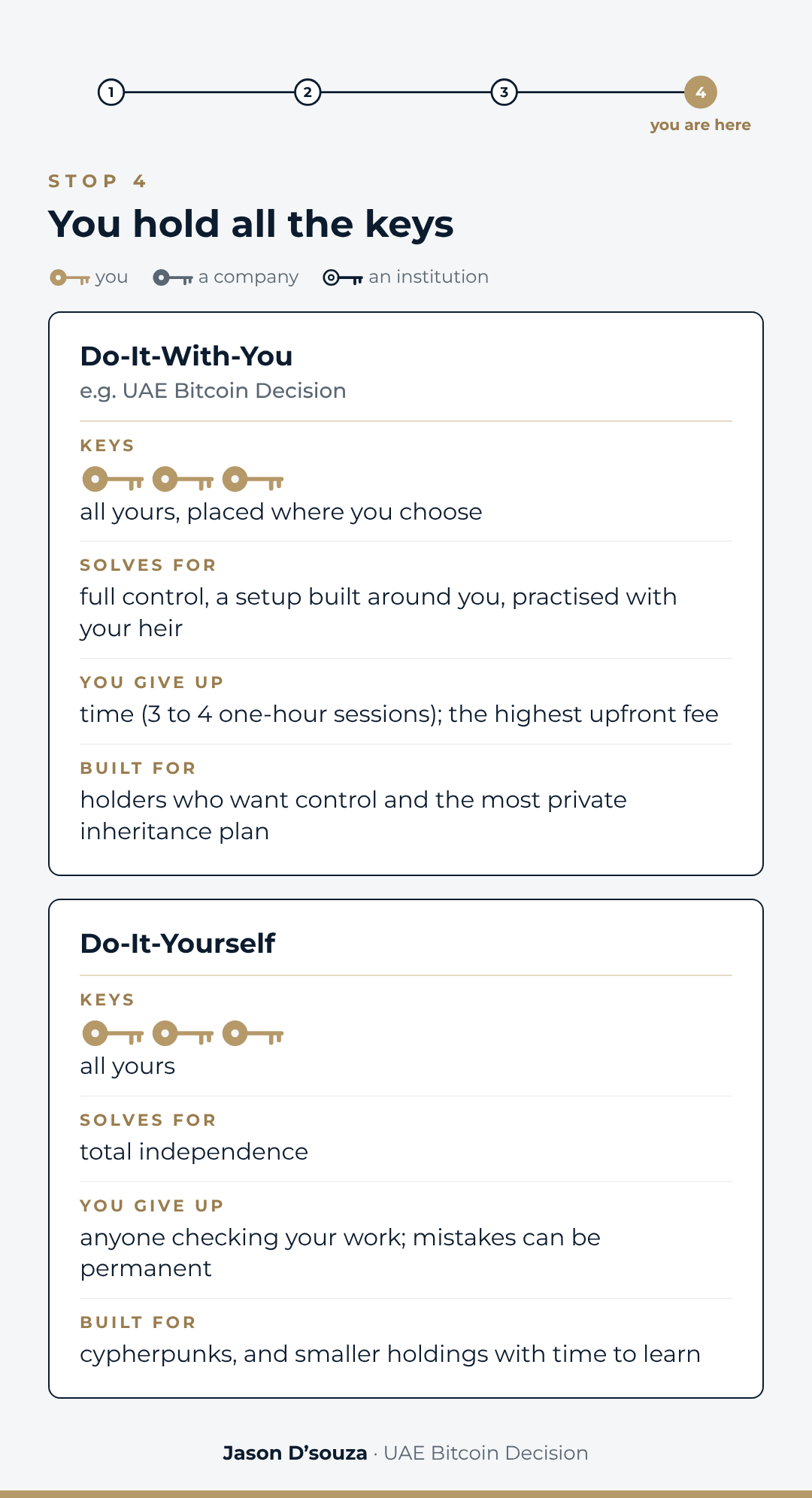
Stop 4You hold all the keys
Much harder for anyone to freeze or seize. And nobody to call if you get it wrong.
This is closest to the original idea of bitcoin, and the highest form of independence. It's also where every bit of responsibility is yours.
Do-It-With-You is what I do at UAE Bitcoin Decision, so read this with my bias in mind. Think of a locksmith who installs your lock, trains your family to use it, and never keeps a copy of the key. Then you practise: a recovery drill, like the fire drill in your building, boring until the day it matters. Do-It-Yourself is rewiring your villa after watching a tutorial. Often fine, until it isn't.
The whole picture
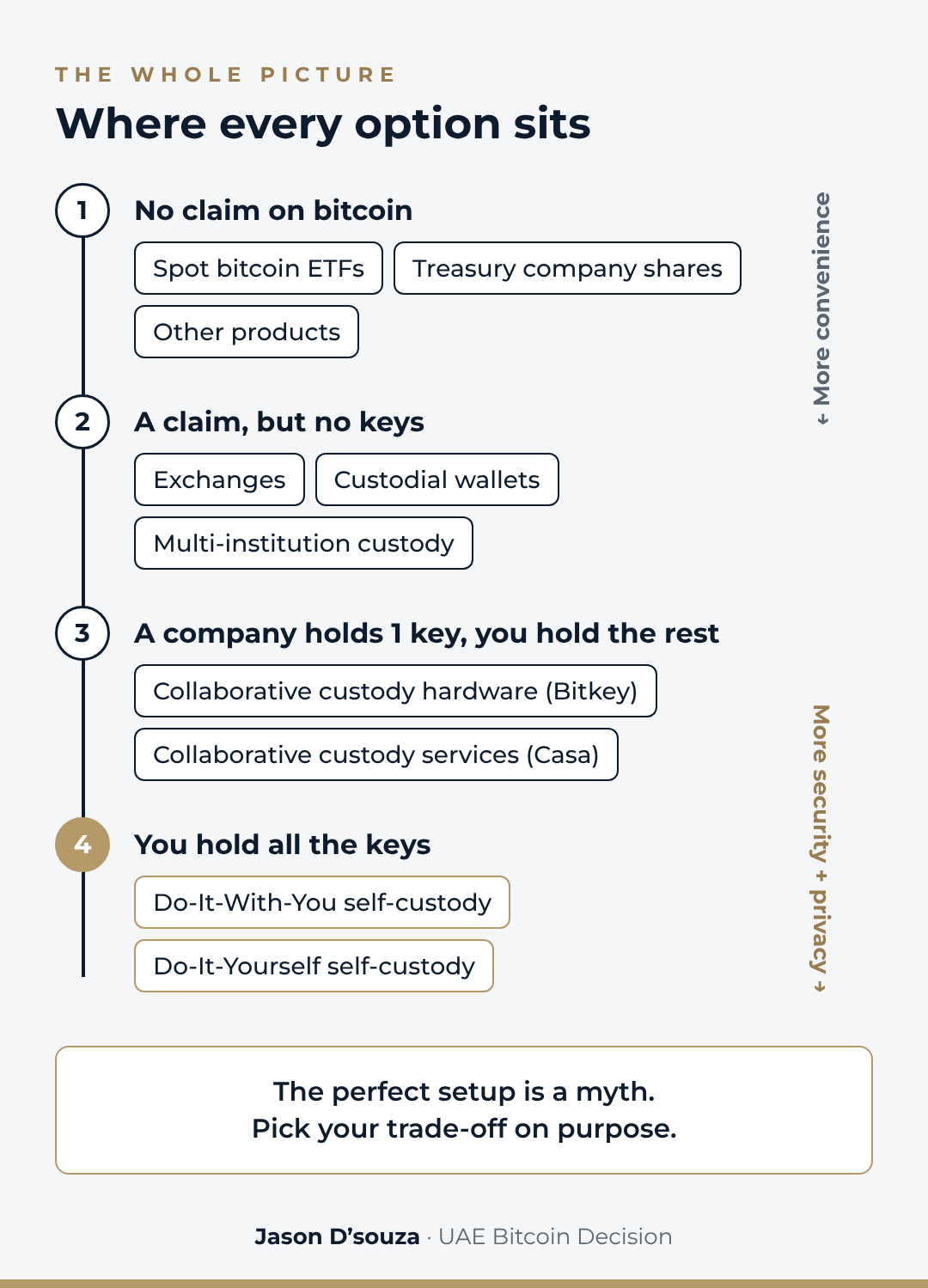
The perfect setup is a myth. Every stop solves for something real and charges you for it somewhere else. The right one matches the risks you're protecting against and the convenience you're willing to give up, and it's one you chose on purpose rather than drifted into.
Like life, bitcoin is not black and white. Exploring the grey requires nuance and a certain framing.
Your one step this week
Find yourself on the map. Three questions are enough.
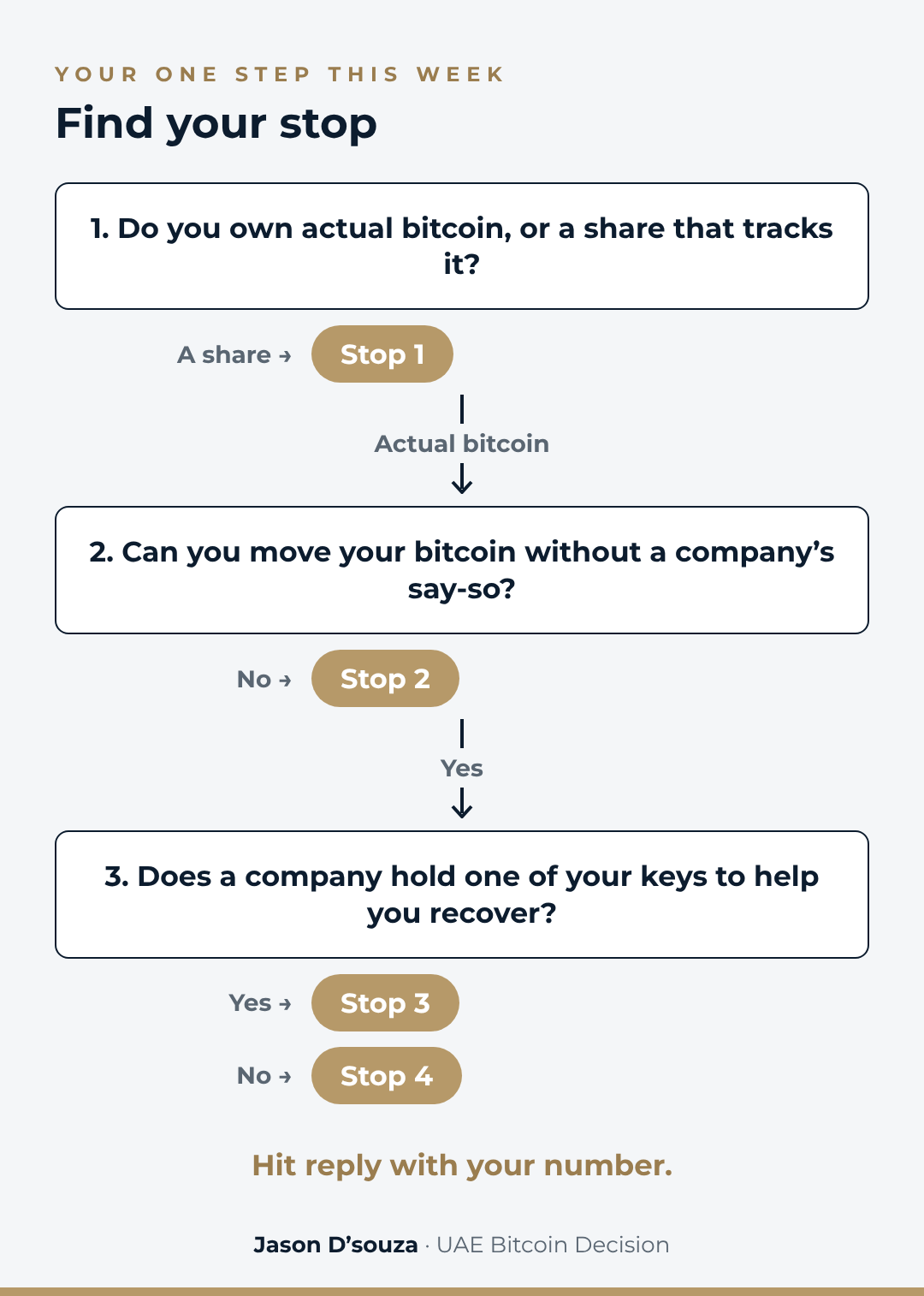
Then write down your stop and the one risk you most want it to protect you from. No seed words, no amounts, nothing anyone could use. And ask yourself honestly: did I choose this trade-off, or drift into it?
Hit reply and tell me which stop you're at, 1 to 4. One number is enough.
Keep evolving.
Jason
P.S. Not sure which setup fits you? The 4-question quiz matches you to a setup profile in about two minutes. Find your setup profile. And if a friend holds bitcoin, forward this to him.
Keys & Kin
Bitcoin, privacy and inheritance for UAE families.
One short issue every Saturday at 09:00 GST.
Get it every Saturday